In February 2021, LGBT+ Rights Ghana shared photos celebrating the opening of their new community office. Within hours, those exact images were circulating across social media, repackaged with a different story. Anti-right groups and individuals claimed that the office was a hub for “recruiting people into homosexuality.” This narrative spread quickly, and within days, police raided the building. Team members and other queer people were outed. Some were forced to flee the country entirely.
One person later recalled: “I was outed when I was not ready.” Forced outing is not an abstract harm, it is a form of digital violence that strips people of safety, autonomy, and control over their own lives. The images of the office were real. Yet, the narrative built around them was fabricated. The social digital platforms did not care about this fabrication, they amplified the outrage across, rewarding the negative engagement with more reach. This failure to distinguish between information and incitement is exactly what they were designed to optimize.
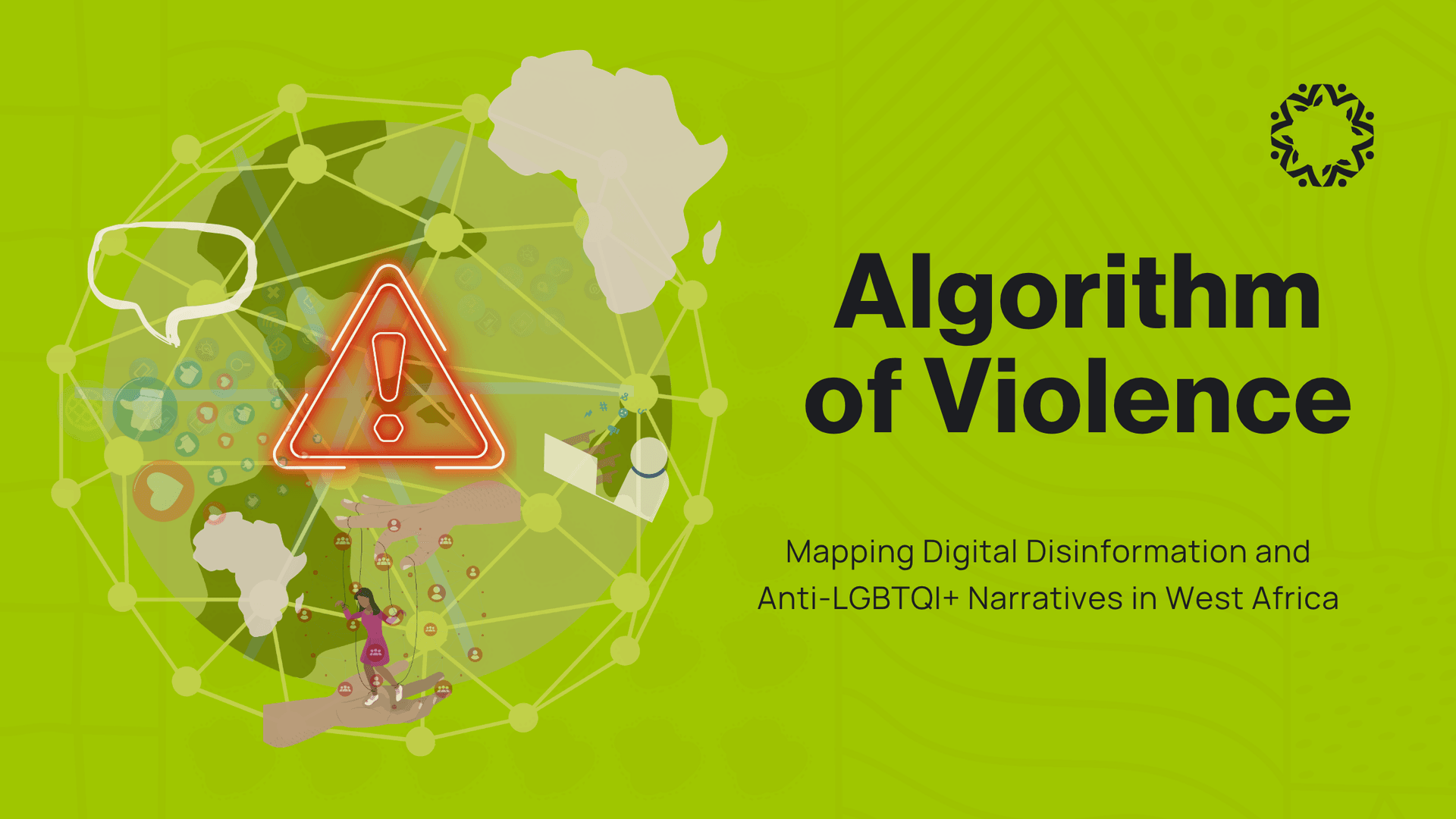
This is the territory that our new research, the “Algorithms of Violence,” occupies. Not as a catalogue of individual incidents, but a structural account of how disinformation, platform design, and political opportunism converge to produce a digital environment where queer Africans are uniquely exposed to harm. Our research across Ghana, Nigeria, Senegal, Côte d’Ivoire, and Togo, interviews with LGBTQI+ advocates and digital experts, analysis of more than 85,000 social media posts, open-source intelligence, network mapping, and testing of how leading AI models interpret African queer language all confirmed this harm.
In Nigeria, 72% of the online discourse we analysed expressed negative sentiment toward LGBTQI+ people. In Côte d’Ivoire, that figure reached 95%. This does not mean West African societies are uniformly hostile but the digital environment is saturated with hostility.
Social media systems are designed to maximise engagement. Content that triggers outrage, fear, and disgust travels further and faster than anything else. Across every country in this study, anti-LGBTQI+ disinformation consistently outperformed counter-narratives in reach and visibility.
When our researchers tested whether leading AI systems could recognise coded LGBTQI+ terms used across West Africa, expressions like “Woubi,” “Trumu Trumu,” “Supi Supi,” and “Lesbobo” Meta’s AI and Grok largely failed. Most terms were returned with literal or “unknown” meanings, stripped of their social context. The implication of this is stark. The moderation systems used on the platforms most dominant across the African continent cannot recognise the language in which harm against queer Africans is being organised, creating a; What you cannot see, you cannot moderate. What you cannot moderate, your system will permit.
This is more of an algorithmic colonialism than technical oversight. In which, the systematic exclusion of African linguistic and cultural realities from the datasets that underpin global digital governance are alive. When a Ghanaian child with a smartphone understands “Trumu Trumu” but a global platform does not, the problem is not the language. The problem is whose language is treated as worth understanding.
The Dual Vacuum That Holds It All Together
This system is sustained by a dual governance vacuum. On one side are global platforms that cannot, or choose not to, invest in meaningful moderation across African languages and contexts, despite deploying extensive resources in Western markets. On the other side are national regulatory environments that often lack capacity, political will, or independence — and in some cases benefit from the hostile digital climate they help create.
Between corporate neglect and state complicity, hate spreads with impunity. LGBTQI+ people lose safety, livelihoods, and in too many cases, their homes and their lives. And accountability remains elusive.
This is not a gap in governance but rather a design choice. Algorithmic systems are not passive conduits of information. They shape what becomes visible, what becomes credible, and who is protected. When those systems consistently amplify narratives that endanger already marginalised communities, they become instruments of exclusion rather than tools of connection.
Queer West Africans deserve digital spaces that do not betray them. Movements deserve platforms that do not profit from their persecution. And conversations about digital rights in Africa must be led by the communities living with the consequences of algorithmic failure every day.