We went to Dakar for the 89th Ordinary Session of the African Commission on Human and Peoples' Rights (ACHPR) knowing it would be one of the hardest regional spaces we had ever entered. We went anyway, because staying away was exactly what the moment was designed to make us do.
CHEVS has always shown up in multilateral spaces to defend the rights of LGBTQ+ and SOGIESC people. These spaces are ours too, and we refuse to cede them to the anti-rights movement. Our goals for Dakar were concrete: meet decision makers, build partnerships, and create a safe space for SOGIESC activists to be present and be heard. This is our honest reflection on what we did, what went well, where we fell short, and what needs to change about solidarity.
Into the mouth of the lion
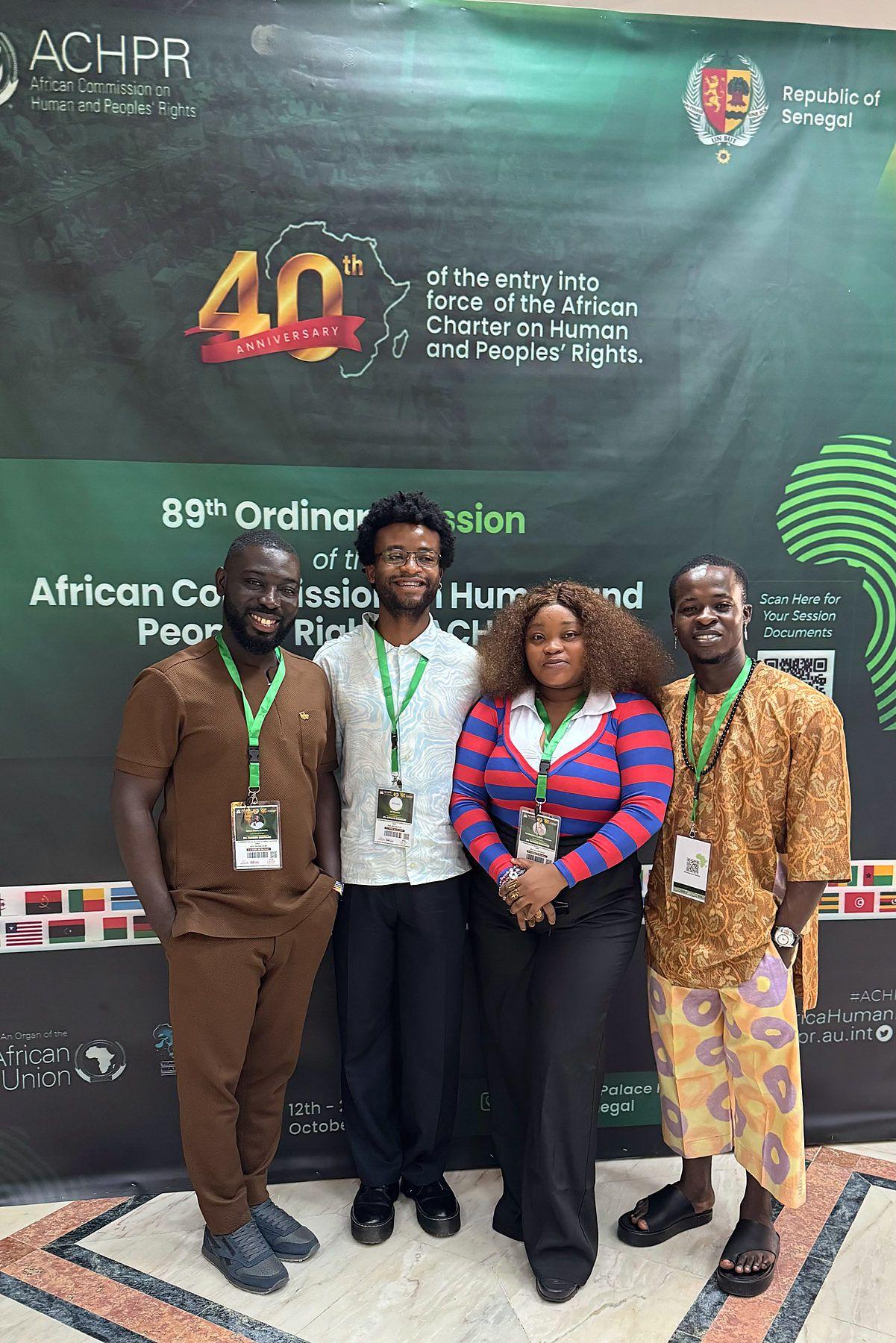
Long before we boarded our flights, Dakar was already part of our daily work. For months we had been giving advice and emergency support to activists and organisations in Senegal, and we had carried out a human rights-based legal analysis of the situation there.
The information emanating from Dakar was relentless: arrests, forced HIV testing, Anal examination and the publication of people's HIV results. Senegal's new law had created a chilling effect on activists. For many delegates, the 89th Session was just another session but for SOGIESC advocates, it felt like walking into the lion’s den. Many in the movement even asked why the Commission had chosen Dakar as the venue at all.
That fear shaped everything about our preparation: our concept notes, our venue choices, and how visible to be. But it is so easy to get lost in the technical language of "risk" and "security" that one forgets to ask the important questions – : Risk to whom? Security for whom? It is easy to forget the very real human implications of the situation. We did not have that luxury. And so, we found ourselves wondering, “Would our phones be searched? Could the police simply pick one of us up for being a feminine-presenting man? Could hosting a side event be enough to get us arrested?”
If we are honest, we were scared, and part of us would rather not have gone. But we understood that was the precise purpose of the criminalisation: to make queer people invisible, to push people like us out of public life, and our absence would only have fulfilled that purpose. We came to recognise that our mere presence at the ACHPR session in Senegal, in and of itself, was part of the answer. We were not going to surrender the space – our space – without contest.
So we prepared. We invested heavily in the development and coordination of a security guide. Our advocacy team led consultations with activists still living in Senegal, people who had gone into exile , and people affected by the law who had fled to neighbouring countries. One question kept coming back: if visiting SOGIESC activists were exposed, would the possible consequences of our advocacy fall only on us, or also on the people who still live in Senegal? That question guided where we went, who we met, and how openly we spoke.
We also asked regional organisations mandated to protect human rights defenders to commit to supporting queer activists if things went wrong. One stopped replying midway through the conversation. Another seemed to be blissfully unaware of the realities SOGIESC activists face in Senegal at all.
Apparently, when people talk about protecting Human Rights Defenders, they don’t mean or include LGBTQI+ rights Defenders. So, even when general protection mechanisms exist, none are designed around our realities, and LGBTQ+ defenders keep falling through the cracks. This has a meaningful impact on advocacy for the rights of LGBTQIA+ people on the continent: if you do not believe anyone will come for you when things go wrong, you cannot speak with the same boldness to claim and defend your rights. That is why our communities need to organise, mobilise, claim all multilateral human rights spaces and build our own protection infrastructure that is fit for purpose.
Fear, and increased risk, also carries a hefty price tag. We needed hotels with real security. We could not eat at the ordinary places we would normally choose. Fear reached even into what we chose to wear. Many partners could not afford to come at all.
These compounding pressures decided who got to be in the room before the session began, and they show the difference between formal and substantive accessibility. The doors were open to us on paper. In practice, criminalisation, fear and cost kept many of us outside and disengaged. As we will show later, cost is the thread that runs through this whole story.
What we did in Dakar
Once on the ground, the fear did not go away. In restaurants we reminded each other to lower our voices. We were constantly looking over our shoulders, hoping to get back to our beds without any contact with the police. Anxiety and hypervigilance has a personal and physical cost, and we ended each day exhausted.
Our delegation’s work began at the NGO Forum where we found no coordination of SOGIESC work there. So we did it ourselves. We sought out the queer activists present, brought them together, and talked about how colleagues from across the continent could engage meaningfully. We reached out to partner organisations that had brought SOGIESC activists, so that no one was left on their own. Our goal was to form a special interest group on sexual and gender minorities and to submit a joint statement for inclusion in the final Civil Society Report. We did not manage to achieve our goal this time, but we will try again at the next session. The Forum was about 40 minutes from the session venue, and with only two of us covering everything, we could not hold it all at once. But the conversations started there.
From the Forum, we carried this work into the session itself. We engaged with allied Commissioners to bring LGBTIQ+ human rights concerns into the spaces where decisions are shaped, strengthen relationships with key regional human rights actors, and sustain dialogue on the protection of our rights. These engagements were critical to ensuring that our presence went beyond participation to building influence within the African human rights system.
Our side event was successful, and we also participated in several other events to learn, listen, and understand the movement’s evolving thinking, priorities, and gaps.
Held under the theme “40 Years of the African Charter: Consolidating Civil Society Action to Defend Africa’s Human Rights Architecture,” our side event brought together diverse movements, organisations, and LGBTIQ+ activists to identify opportunities for stronger collaboration, coordinated advocacy, and collective action to protect and strengthen Africa’s regional human rights mechanisms. By creating space for cross-movement dialogue, the event helped situate LGBTIQ+ rights within the broader struggle to defend the continent’s human rights architecture and reinforced the importance of solidarity in responding to growing threats to human rights.
The litigants group welcomed us and heard our assessment of SOGIESC rights across the region. We accompanied the fellows on our Wedging Justice programme as they navigated the session. And before we arrived, we had submitted input on the Commission's draft declaration on the protection of human rights defenders, so that an LGBTQ+ perspective would be on the record.
Our realities, missing from the agenda
Inside the session, debates spoke directly to our lived realities: cross-border abuses and refugee crises, repressive laws, state actors violating rights, denial of water, sanitation and healthcare, violence by non-state actors, and reprisals against activists. Yet not once did these conversations name the LGBTQ+ community, one of the most excluded on the continent. The situation in Senegal, the very thing that made us so afraid, was not an agenda item for civil society or for the Commission. It did not appear even as a footnote.
We also have to be honest about why. Who did we expect to raise it for us? Our movement has been largely absent and uncoordinated in this space, because of funding, because of prejudice, and because no organisation has consistently stepped up to hold it. When we are not in the room, these conversations go ahead without us, anti-rights voices fill the silence we leave, and our communities continue to be used as pawns in political games.
Where we wanted to do more, and the Forum's silence
We searched for spaces to speak openly about the crises in Senegal and, indeed, across the Sahel. Looking back, we regret the only places we could speak about it were spaces where we had control and knew the risk was less. We wish we could have done more.
The chilling effect of the law was real, and we were navigating genuine uncertainty as to whether the deliberations at the NGO Forum fell within the aegis of the ACHPR. It did not help that the Commission provided no response to the formal request for protection and assurances from a coalition of civil society organisations. This does not erase our regret, but it contextualises our decision.That choice told LGBTQ+ defenders that our safety was not part of the planning. No assurance of protection came, and no space was made to speak about what was happening in the host country. A Commission charged with protecting human rights defenders cannot convene them where some of them are being hunted, and say nothing.
The silence went beyond the Commission. Mainstream human rights movements, many of them our allies on paper, deliberated for days in Dakar without us, and without any visible concern for our issues or our safety. Solidarity that stops where our community begins is not solidarity. Over this strategic period, CHEVS will work to change that: pressing the Commission to weigh the safety of all defenders when it chooses where to meet, and building real cross-movement solidarity, so that no regional space treats LGBTQ+ defenders as an afterthought.
What we learned, and what we ask
Preparation is protection. Commission work happens between sessions too. Regional advocacy carries its own dangers, from activists' own governments and from the host government. And we must build our own platforms while claiming space in existing ones: the campaign for an AU convention on ending violence against women and girls needs a strong LBQ framing, the campaign around Article 59 (1) of the African Charter matters if more SOGIESC communications are to reach the Commission, and regional SOGIESC litigation should become a focus of the litigants group.
Staying the full session matters too. For funding reasons, we left after the first week. So, we couldn't meet with Commissioners at times that suited them, and we missed the African Human Rights Day event on 21 October, a natural moment to raise SOGIESC issues.
The heart of the matter is that LGBTQ+ presence at the Commission has not been consistent, funding lies at the root of this. Queer organisations keep showing up whenever they can afford to, which proves the commitment is there and the mechanisms are useful. What is missing are the resources to keep activists engaged. With the Commission's current composition, our immediate goal may be to hold the space rather than move the needle, so that contested issues are not settled against us and we remain ready to take advantage of any rights-positive changes. Anti-rights actors are working hard to capture these spaces, against LGBTQ+ people, women and other minorities. We will not hand them that victory by staying home.
Holding our ground needs core, long-term and flexible funding for regional SOGIESC advocacy; support for full participation from the NGO Forum to the end of the session; funding for activists' travel, so cost does not decide who is in the room; and protection mechanisms designed around African SOGIESC defenders.
For our part, we will share our full report with partners, activate a coordination group, revive the special interest group and deepen our work with the litigants group.
What went well: partnership and queer joy
First, and not trivially: we were not arrested.
But beyond that, a great deal went right. Partners including the Initiative for Strategic Litigation in Africa (ISLA), Akina Mama wa Afrika, FEMNET, the Zamara Foundation, MOLI and Galck+ chose to co-create a movement space with us.
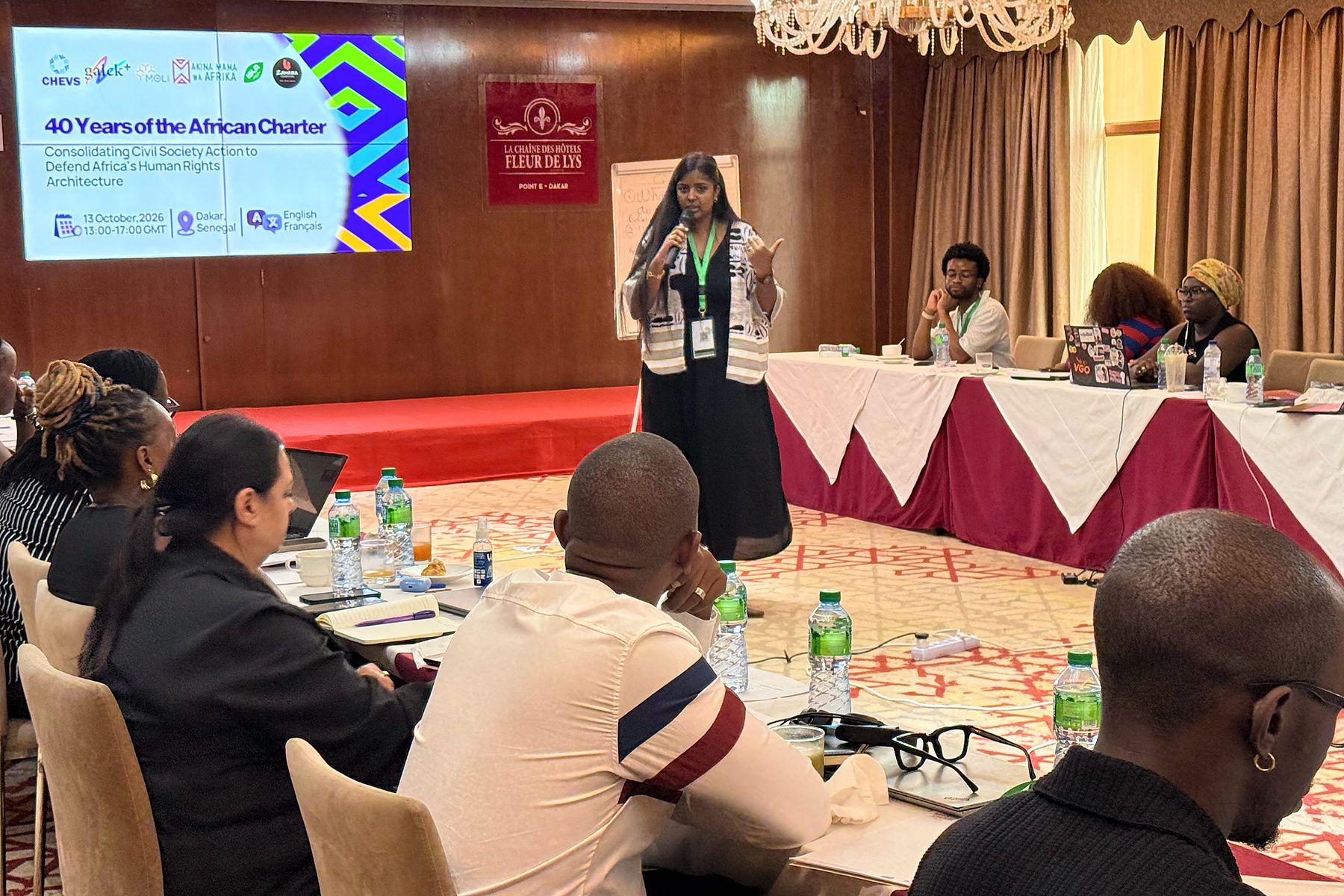
Our convening role mattered. Several activists were at a regional session for the first time, and without community, people get lost in these systems. Because we brought people together, they told us they felt seen, heard and relevant. We built trust across countries and set up a group to anchor coordination for future sessions. In Dakar, our role stopped being abstract: we are mobilising movement power for our rights
And this is what stays with us most. A law had prepared fire and brimstone for our community, yet the spaces we created were full of queer joy, so visible that non-queer delegates sought them out too. We walked each other to venues and around town, waited for each other, and checked in: Where are you? Are you coming to this session? Let’s go have lunch? These are the relationships that will outlast the session. Being recognised and happy together is how a movement sustains itself. In a city where the law wanted us silent and hidden, our joy and visibility was itself an act of resistance.
We will be back
Dakar asked a great deal of us. We arrived afraid and left before we wanted to. But we left with new partners, a growing network of activists who trust each other, and a much clearer picture of the role CHEVS must play. The lesson of the 89th Session is simple: if we are absent, we are erased. Our realities will not reach the agenda unless we put them there, together.
To our communities: you are not alone in these spaces. To fellow civil society organisations: make room for SOGIESC voices in your coalitions and statements, and prepare with us before the next session. To funders: invest in consistent, core support so we can stay in the room for as long as it takes.
We were in Dakar. We will be at the next session too. These spaces are ours, and we are not giving them up.